

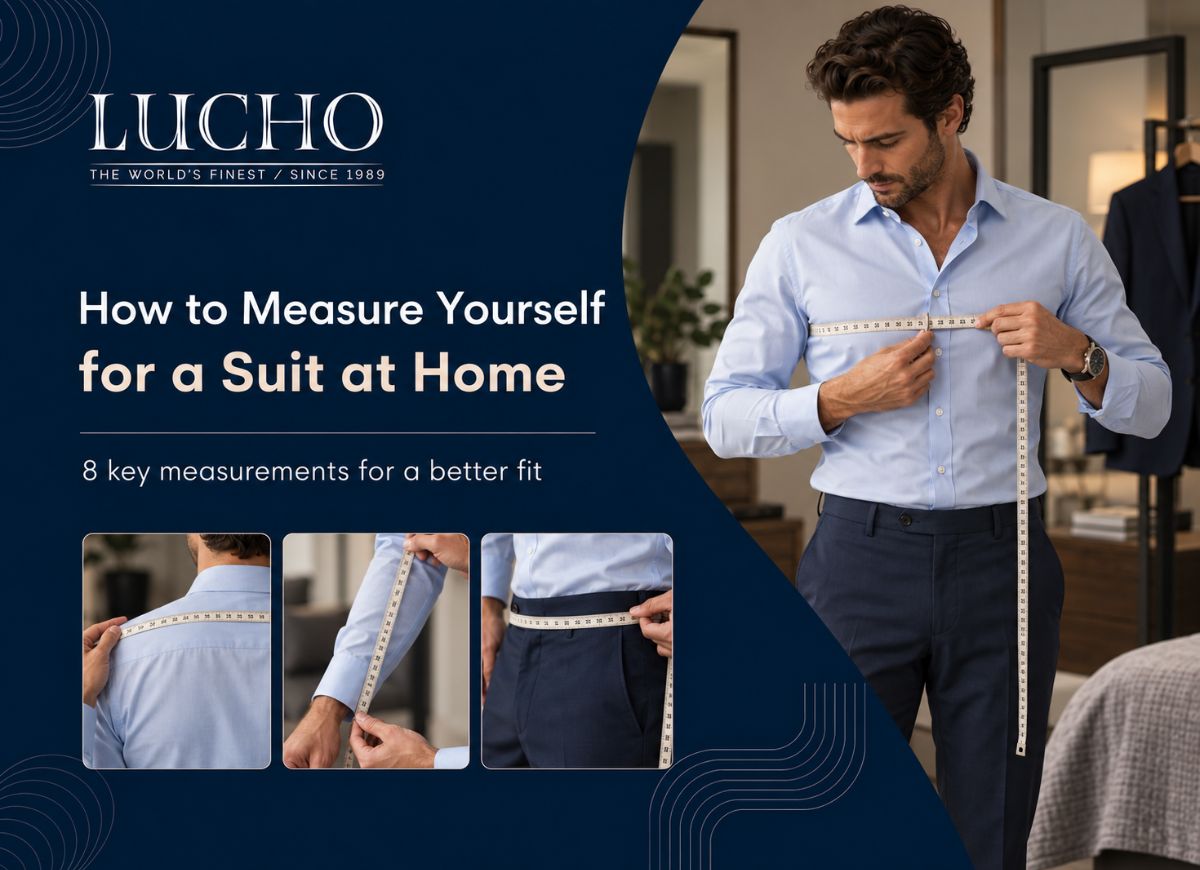
How to Measure Yourself for a Suit at Home (Easy Guide)
You can measure yourself for a suit at home in about ten minutes with just a soft tape measure and a shirt that fits close to your body. You need eight numbers: chest, shoulders, sleeve, neck, natural waist, trouser waist, hip, and inseam. Write each one down as you go, and keep the tape snug against your body without pulling it tight.
Table of Contents
ToggleThat is the short version. Below, we will walk through each measurement one at a time, show you exactly where to place the tape, and cover the mistakes that throw off a home measurement the most. Whether you are ordering a suit online, getting fitted for a custom suit, or just want to know your size before you shop, these steps work the same way every time.
Fit is the number one reason clothes get returned or altered. A jacket can be made from the finest wool in the world, but if the chest is an inch too tight or the sleeves hang past your wrist, none of that quality will matter to the person looking at you. The good news is that suit measurements follow a repeatable process. You are not guessing. You are taking objective numbers with a tape measure, the same way a tailor would, just without the fitting room.
What You Need Before You Start
Gather these three things first. Trying to measure without them is where most mistakes happen.
- A soft fabric tape measure. A metal tape from a toolbox will not curve around your body correctly. If you do not own a fabric one, a piece of string laid flat against a ruler works as a backup.
- A close-fitting shirt. Loose or bulky clothing adds extra inches to every number. A plain t-shirt or dress shirt gives you the most accurate read.
- A helper, if possible. A few measurements, especially the shoulders and jacket length, are much easier with a second set of hands. You can do all of them alone in a mirror if needed, but a helper improves accuracy.
Stand naturally while you measure. Do not suck in your stomach or puff out your chest. The tape should sit snug against your body, close enough that it will not slide, but loose enough that you can slip one finger underneath it. That one rule, snug but not tight, applies to every measurement on this list.
The 8 Measurements You Need for a Suit
1. Chest
Wrap the tape around the fullest part of your chest, passing under your arms and across your shoulder blades in the back. Keep the tape level and parallel to the floor the entire way around. This is the single most important number for jacket size, so take it twice to be sure both readings match.
2. Shoulders
Measure across your back from the edge of one shoulder to the edge of the other, following the natural curve of your body. This is easiest with a helper, since you need to find the exact point where your shoulder ends and your arm begins on both sides. A jacket with the wrong shoulder width is one of the hardest fit problems to fix later, so it is worth taking your time here.
3. Sleeve Length
With your arm relaxed and slightly bent, measure from the top of your shoulder bone down the outside of your arm to your wrist bone. A properly fitted jacket sleeve should stop right at your wrist bone, letting about half an inch of shirt cuff show underneath.
4. Neck
Wrap the tape around the base of your neck, where a buttoned shirt collar would naturally sit. Leave enough room to fit one finger between the tape and your neck. This number matters most for dress shirts, but it is worth recording for a full suit order.
5. Natural Waist
Find your natural waist, which is the narrowest part of your torso, usually an inch or two above your belly button. Wrap the tape around it while breathing normally. This measurement shapes how your jacket is cut, so it is different from the waist measurement on your pants.
6. Trouser Waist
This is where you actually wear your pants, which for most men sits lower than the natural waist, closer to the hip bones. Wrap the tape around that point without pulling it tight or sucking in. This number, not your natural waist, is what determines your trouser size.
7. Hip (Seat)
Measure around the fullest part of your hips and backside, keeping the tape level all the way around, including behind you. This number affects how your trousers fit through the seat and thighs.
8. Inseam
Measure from the top of your inner thigh straight down to your ankle bone. The easiest way to get this right is to measure a pair of pants that already fits you well, laid flat, from the crotch seam down to the bottom of the leg.
Bonus: Jacket Length
Some sellers also ask for jacket length, which runs from the base of your collar, where your neck meets your spine, straight down your back to where your seat ends. This one is almost impossible to do alone since you cannot see your own spine in a mirror, so save it for when a helper is available or skip it if your supplier does not ask for it.
Turning Your Numbers Into a Size
Once you have all eight measurements written down, most suit sellers, whether online or in person, will match them to a standard size chart using your chest and waist as the two anchor numbers. Height also plays a role, since a taller man and a shorter man with the same chest measurement often need different jacket lengths and sleeve lengths to look proportional.
If your numbers do not land neatly inside one size on a chart, the safer move is almost always to size up rather than down. A jacket that is slightly large can be taken in at the shoulders, waist, and sleeves by a tailor. A jacket that is too small often cannot be let out enough to fix the problem, since there is only so much extra fabric hidden in the seams.
Common Mistakes That Throw Off Your Measurements
Even careful people get these wrong the first time. Watch for these before you send your numbers anywhere:
- Wearing bulky clothing. A sweater or jacket over your shirt can add a full inch or more to your chest and waist numbers.
- Pulling the tape too tight. This shrinks every measurement and leads to a suit that feels tight the moment you put it on.
- Measuring only once. Numbers can shift slightly depending on your posture. Take each measurement twice and use the average if they do not match exactly.
- Guessing the natural waist and trouser waist are the same number. They are almost always different, sometimes by two or three inches, and mixing them up leads to trousers that either gap at the back or squeeze at the front.
- Skipping the helper for shoulder width. This is the hardest measurement to get right alone, since you cannot see your own back clearly in a mirror.
- Measuring at the wrong time of day. Your body can shift slightly after a big meal or a long day on your feet. Measuring first thing in the morning, before you have eaten, tends to give the most consistent number.
- Rounding numbers up or down. A measurement of thirty nine and a half inches is not the same as forty. Write down the exact number, including the half inch, rather than rounding to whatever feels close enough.
Suit Measurement Quick Reference
| Measurement | Where to Place the Tape | Common Mistake |
|---|---|---|
| Chest | Fullest part of chest, under arms, across shoulder blades | Pulling the tape too tight, shrinking the number |
| Shoulders | Edge of shoulder to edge of shoulder, across the back | Guessing instead of finding the exact shoulder point |
| Sleeve | Shoulder bone to wrist bone, arm slightly bent | Measuring with the arm fully straight |
| Neck | Base of neck, where a collar sits | Leaving no room for one finger underneath |
| Natural waist | Narrowest point of the torso | Confusing it with trouser waist |
| Trouser waist | Where pants actually sit, near the hip bones | Sucking in the stomach while measuring |
| Hip | Fullest part of hips and seat | Letting the tape sag in the back |
| Inseam | Inner thigh to ankle bone | Measuring standing pants instead of a flat pair |
Do You Really Need a Tailor to Check Your Numbers?
Home measurements are reliable enough to shop with confidence, especially if you follow the steps above carefully and double check each number. But even a small error, like an inch off on the shoulders, can be the difference between a suit that hangs well and one that needs several rounds of professional suit alterations after the fact.
That is why many men treat home measurements as a starting point rather than a final answer. Taking your own numbers first, then having a tailor confirm them in person, catches small errors before they turn into a suit that never quite sits right. This matters even more for a suit you plan to wear often, since the cost of getting it wrong shows up every time you put it on.
Frequently Asked Questions
What is the most important measurement for a suit?
The chest measurement matters most, since it drives the overall jacket size. Get this number right and most of the rest of the jacket will fall into place around it.
Can I measure myself without help?
Yes, for most measurements. Chest, waist, neck, and inseam are all doable alone in a mirror. Shoulder width is the one measurement where a helper makes a real difference in accuracy.
How do I know if my measuring tape reading is accurate?
Take each measurement twice. If the two readings match within a quarter inch, trust the number. If they do not match, take a third reading and use the two closest numbers.
Should I measure over bare skin or over clothing?
Measure over a thin, close-fitting shirt. Bare skin can cause the tape to slip, and thick clothing adds extra inches that were never really there.
What if my measurements fall between two standard suit sizes?
This is common and normal. When your numbers land between sizes, sizing up and having the jacket taken in slightly at the waist or sleeves almost always gives a better result than sizing down and hoping it stretches.
How often should I remeasure myself?
Once a year is a good habit, or any time your weight changes by more than five or ten pounds. Bodies shift gradually, and a measurement taken two years ago may no longer match who you are today, even if the change feels small day to day.
The Bottom Line
Measuring yourself for a suit is a ten minute job once you know where to place the tape. Chest, shoulders, sleeve, neck, natural waist, trouser waist, hip, and inseam are the eight numbers that matter. Write them down, double check anything that looks off, and you will walk into your next suit purchase, online or in person, with real confidence instead of a guess.
If you want those numbers checked by a professional before you commit to a purchase, Lucho’s custom suit fittings in Houston take the guesswork out completely, with a tailor confirming every measurement in person.
Contact Us
Recent Posts
- Your First Custom Suit Fitting: What Happens and How to Prepare
- What Is Cocktail Attire for Men? A Simple Guide
- Wool vs Linen vs Cotton: Best Suit Fabric for Houston Heat
- What to Wear to a Cigar Lounge: A Men’s Style Guide
- How to Measure Yourself for a Suit at Home (Easy Guide)
- Suit vs Tuxedo: The Real Difference (and When to Wear Each)
- The Return of the Double-Breasted Suit: How to Wear It in 2026
- Best Dress Pants for Men: The Ultimate 2026 Fit & Style Guide
- Black Suits Men: Style Guide & When to Wear Them
- Business Casual for Men: Modern Rules and Ideas for 2026