

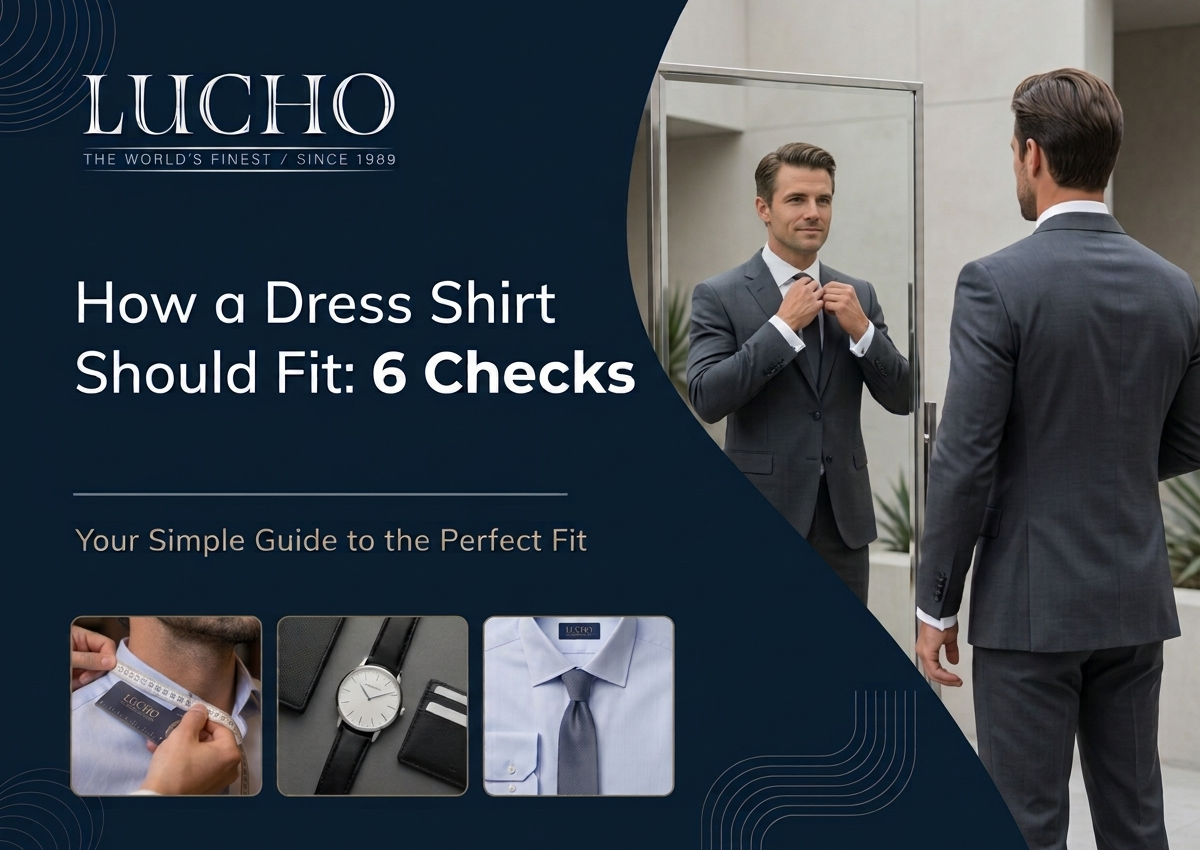
A dress shirt should fit snugly at the collar, sit at the edge of your shoulders, lie flat across your chest, and taper slightly toward your waist. The sleeves should end at your wrist bone, and about half an inch of cuff should show under your jacket. If a shirt pulls, droops, or bunches, the fit is off.
Table of Contents
ToggleMost men never learn how a dress shirt should fit. They pick a size by the neck number, check that the buttons close, and call it done. Then they wonder why the shirt looks a little sloppy in photos.
The good news is that you can learn the basics in five minutes. You do not need to know sewing. You only need to know where to look. This guide gives you six simple checks you can do in front of any mirror. It also shows you what to do when a shirt fails a check.
Why Shirt Fit Matters
A dress shirt is often the first thing people see. Under a suit, the collar and cuffs peek out. Without a jacket, the whole shirt is on display. A shirt that fits well makes you look neat, awake, and ready. A shirt that does not fit makes you look tired, even when you are not.
Fit also affects comfort. A tight shirt pinches when you reach for something. A baggy shirt bunches up and feels hot. Neither is fun on a busy day, and Houston heat makes both worse.
Here is the best part. A fair shirt with a great fit often looks better than an expensive shirt with a poor fit. Fit is the secret.
Check 1: The Collar
Start at the top. The collar frames your face, so it matters most.
The test: Button the top button. Now slide two fingers between the collar and your neck. They should fit without force.
- If you cannot fit two fingers, the collar is too tight. It will feel like a choke by lunch.
- If you can fit three or more fingers, the collar is too loose. It will gape, and your tie will hang badly.
A few more points:
- The collar should touch your neck all the way around, but not press hard.
- If you wear a tie, the collar should stay close to your neck when you turn your head.
- If you never button the top button, collar tightness matters a bit less. Then focus on the other five checks first.
Tip: Your neck size can change with weight, age, or exercise. Get measured again once a year.
Check 2: The Shoulders
Shoulders are the hardest part to fix later, so check them first when you shop.
The test: Look at the seam where the sleeve meets the body of the shirt. It should sit right at the edge of your shoulder bone.
- If the seam sits up toward your neck, the shirt is too small. The fabric will pull and wrinkle.
- If the seam slides down your upper arm, the shirt is too big. It will look droopy.
Also look at the back. The fabric across your upper back should be smooth. If you see pulling lines, the shirt is too tight there.
Mass-market shirts are often cut wide in the shoulders so they fit more people. That is why many men see the seam sliding off. A made-to-measure shirt avoids this because it is cut for your shoulders.
Check 3: The Chest
The test: Stand up straight and look at the buttons on your chest. The shirt should lie flat with no pulling.
- If you see small pinches or “smiles” of fabric between buttons, the shirt is too tight.
- If the fabric hangs in loose folds across your chest, the shirt is too big.
Now move. Reach forward like you are shaking hands. Lift your arms. Cross them in front of you. You should be able to do all of this without feeling like the shirt might tear. A good shirt fits closely but still lets you move.
Check 4: The Body and Waist
The body of the shirt is where fit styles differ. Here are the three main types.
Fit type | What it looks like | Best for |
Slim fit | Close to the body, tapered at the waist | Lean or athletic builds, modern looks |
Classic (regular) fit | Straighter cut with more room | Broader builds, all-day comfort |
Tailored or custom fit | Made for your exact shape | Any body, especially if standard sizes never fit |
The test: Pinch the fabric at your side, at the waist. If you can grab more than about two inches, there is too much extra fabric. It will billow out when you tuck the shirt in and look messy under a jacket.
Also check the length. If you plan to tuck the shirt in, it should be long enough to stay tucked when you lift your arms. If you plan to wear it untucked, it should end around the middle of your seat, not below it.
A quick note on tucking. A dress shirt is made to be tucked in. Wearing it untucked with a long tail looks sloppy. If you like the untucked look, choose a shirt made with a shorter hem.
Check 5: The Sleeves and Cuffs
Sleeves are easy to check and easy to get wrong.
The test for length: Let your arms hang at your sides. The cuff should end at the hinge of your wrist, just covering the wrist bone.
Now put on a suit jacket. About half an inch of shirt cuff should show below the jacket sleeve. This small line of white looks sharp and polished.
- If the cuff hits your knuckles or the back of your hand, the sleeve is too long.
- If your wrist bone is fully bare and the sleeve rides up when you reach, it is too short.
The test for width: The sleeve should be a bit wider at the upper arm and taper toward the cuff. You should be able to bend your elbow without the sleeve pulling. The cuff should be snug enough that it does not slide over your hand, but you should be able to get a finger between the cuff and your wrist.
A note on cuffs: If you wear a watch, a slightly wider cuff may be needed so the watch sits comfortably. Check this before you buy.
Check 6: The Full-Body Look
Finally, step back and look at the whole picture.
- Do you see any strange wrinkles across the stomach or back? Those are signs of a tight spot.
- Does the shirt hang straight from your shoulders, or does it swing out?
- When you lift your arms, does the shirt stay put?
- When you sit down, does anything pull, gap, or pop open?
The sitting test matters a lot. Many shirts look fine standing, then gap at the buttons when you sit. Try sitting down in the store or at home before you decide.
Quick Fit Guide: Spot the Problem, Find the Fix
Problem you see | What it means | What to do |
Collar gaps when tie is on | Too big at the neck | Size down or have the collar adjusted |
Seam drops off shoulder | Shirt too big overall | Size down, or choose a shirt cut for you |
Pulling at chest buttons | Shirt too tight | Size up or try a classic fit |
Fabric bunches at waist | Too much room | Get the sides taken in |
Sleeves cover knuckles | Sleeves too long | Shorten at the cuff |
Sleeves ride up when you reach | Too short or too tight | Size up in the sleeve length |
Shirt untucks all day | Hem too short | Choose a longer tail |
Some of these problems can be fixed by a tailor. Sleeve length and side seams are common fixes. Shoulder problems are harder and cost more. If the shoulders are wrong, it is usually smarter to start with a different shirt.
Common Mistakes Men Make
Buying by neck size only. A shirt labeled 16 neck may still have arms that are too long or a body that is too wide.
Buying big for comfort. A shirt that is one size too large feels easy at first. But it bunches up, wrinkles fast, and looks sloppy under a jacket.
Ignoring changes in weight. Your size changes over time. A shirt that fit two years ago may not fit today.
Forgetting to wash before you judge. Cotton can shrink a little. If a shirt feels a bit tight after washing, the fabric may have shrunk. Judge fit on a clean, dry shirt.
Skipping the try-on with a jacket. Some shirts look fine alone but bunch under a jacket. If you wear suits, always test with one.
Trusting the tag. Sizes vary from brand to brand. A medium at one store may be a large at another.
When a Custom Shirt Makes Sense
Off-the-rack shirts are made for an average shape. Most men are not average. Maybe you have broad shoulders and a slim waist. Maybe your arms are long. Maybe your neck is thick. If you have ever said, “Nothing fits me right,” a custom shirt may be the answer.
A custom shirt is made from your measurements. That means the collar, shoulders, chest, waist, and sleeves all fit your body. You also get to pick the fabric, collar style, and cuffs. Many men say they never want to go back to off-the-rack after their first one.
You can look at what is available on our men’s shirts page. If you wear dress shirts all week, our shirt club is worth a look too.
Easy Care Tips to Keep the Fit
A shirt that fits well will last longer if you care for it.
- Wash cold or warm. Very hot water can shrink cotton.
- Hang dry when you can. The dryer can shrink and wear out the fabric.
- Iron while slightly damp. It is easier and gives a crisper finish.
- Use collar stays. They keep the collar points flat and sharp.
- Rotate your shirts. Wearing the same one every day wears it out faster.
These small habits keep your shirts looking good for years.
Your 60-Second Fit Test
Try this at home with your favorite dress shirt.
- Button the collar. Can two fingers fit?
- Is the shoulder seam at the edge of your shoulder?
- Does the chest lie flat?
- Can you pinch only a little fabric at the waist?
- Do the sleeves end at your wrist bone?
- Does half an inch of cuff show under your jacket?
If you answered yes to all six, you have a great fit. If you answered no to two or more, it may be time for a new shirt or a visit to a tailor.
Frequently Asked Questions
A dress shirt should be snug but not tight. You should be able to move your arms, sit, and reach without pulling. Two fingers should fit at the collar.
Look for a droopy shoulder seam, extra fabric at the waist, sleeves that bunch, and a collar that gaps. If you can pinch a lot of fabric at your sides, the shirt is too big.
Sleeves should end at your wrist bone. Under a jacket, about half an inch of cuff should show.
Most dress shirts are made to be tucked in. Only wear one untucked if it has a shorter hem made for that look.
Yes, for many problems. Tailors can shorten sleeves, take in the sides, and adjust length. Shoulders and collars are harder to change.
It depends on your body. Slim fit works well for lean or athletic builds. Classic fit is more comfortable for broader builds. A custom shirt fits your exact shape.
Get a Shirt That Fits You
A well-fitted shirt is one of the easiest ways to look sharp. At Lucho, we have been helping Houston men find the right fit since 1989. Come in, and our team will measure you, show you fabric and collar options, and help you build shirts that fit like they were made for you.
Visit us at 3637 W. Alabama, Suite 100, Houston, TX 77027, or contact us to book a time. Call 832-495-8558.
Contact Us
Recent Posts
- How a Dress Shirt Should Fit: 6 Easy Checks
- Your First Custom Suit Fitting: What Happens and How to Prepare
- What Is Cocktail Attire for Men? A Simple Guide
- Wool vs Linen vs Cotton: Best Suit Fabric for Houston Heat
- What to Wear to a Cigar Lounge: A Men’s Style Guide
- How to Measure Yourself for a Suit at Home (Easy Guide)
- Suit vs Tuxedo: The Real Difference (and When to Wear Each)
- The Return of the Double-Breasted Suit: How to Wear It in 2026
- Best Dress Pants for Men: The Ultimate 2026 Fit & Style Guide
- Black Suits Men: Style Guide & When to Wear Them