

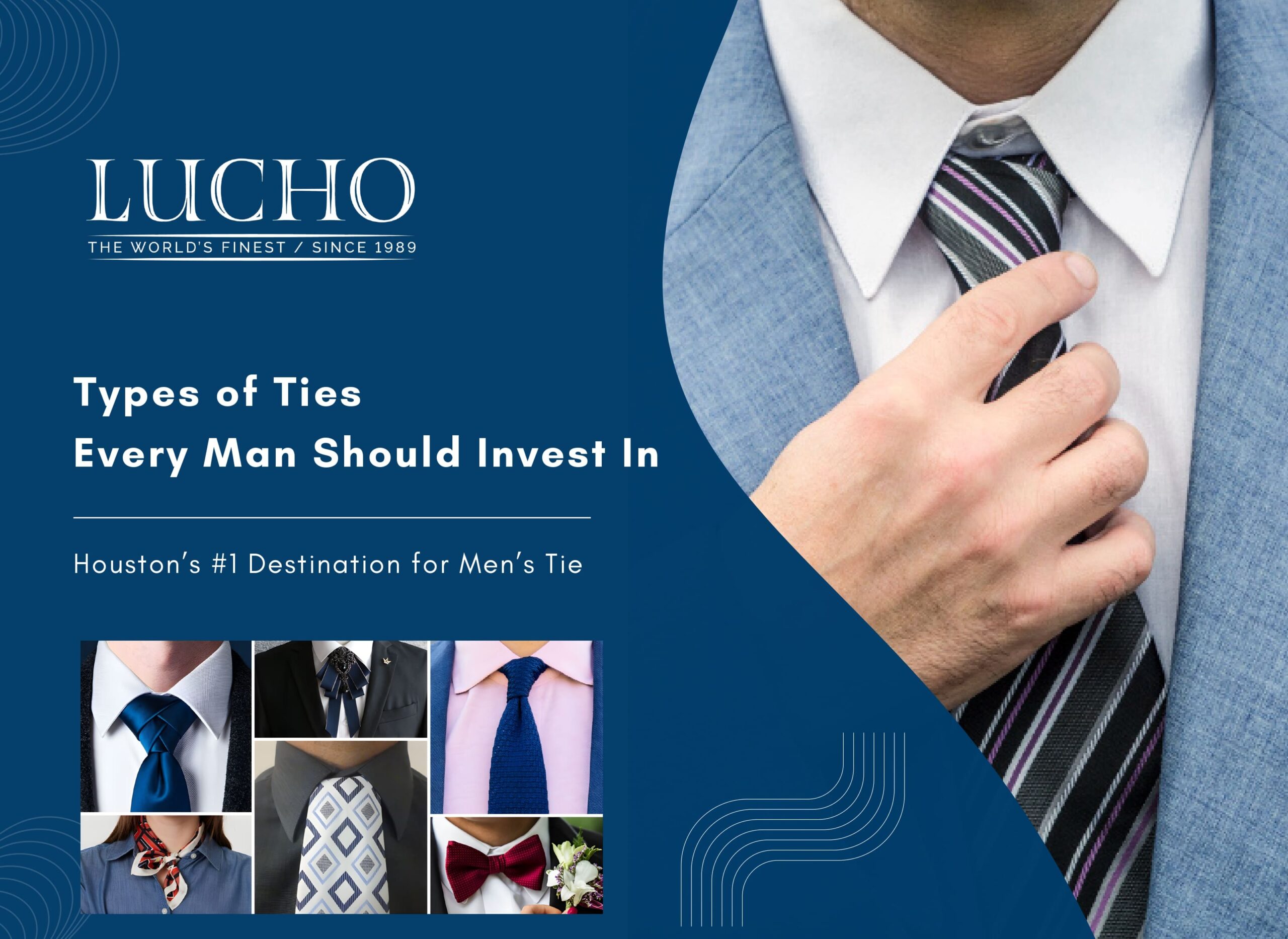
Types of Ties Every Man Should Know (and When to Wear Them)
Standing in front of your closet before a wedding or job interview, unsure which tie to grab, is a common problem. Most men own a few ties without knowing what each style is for or when one works better than another. This guide walks through every major type of necktie, what it looks like, when it fits the occasion, and which fabric and width work best.
Table of Contents
ToggleTie Width, Explained in Plain Terms
A skinny tie sits under 2.5 inches wide, sometimes labeled a slim tie or narrow tie. A wide tie from the 1940s or 1970s, often 4.5 to 6 inches, goes by the name kipper tie. A standard tie runs 3 to 3.5 inches, the width most brands cut by default. A short tie has no separate name of its own; it’s a standard tie tied with a shorter drop instead of a distinct style.
1. Standard Necktie (Four-in-Hand Tie)
The standard necktie is the design most people picture first. It measures around 57 inches long and 3 to 3.5 inches at the widest point, the most versatile necktie style in a man’s closet and appropriate across nearly every dress code.
Silk suits formal settings, polyester holds up for daily wear, and wool or cotton fit smart-casual outfits. For the knot, a Four-in-Hand gives a quick, slightly asymmetrical shape, a Half Windsor lands somewhere in the middle, and a Full Windsor forms a wide, formal triangle. New to tying a knot? Our how to tie a tie guide breaks down all four methods step by step.
2. Skinny Tie
A skinny tie measures 1.5 to 2.5 inches at its widest point, noticeably narrower than a standard tie. The style rose in the 1950s and 1960s, faded through the 1980s, and returned strongly in the 2000s, staying popular since.
Are skinny ties still in style? Yes, with a caveat. The trend right now leans toward medium and slightly wider ties, in the 2.75 to 3.25 inch range, especially for professional settings. Skinny ties read as fashion-forward and suit creative industries, modern weddings, and casual events. They pair best with slim builds and fitted, narrow-lapel jackets; on a wider lapel or heavier build, the proportions look off.
Skinny tie vs regular tie comes down to proportion, not formality. A regular tie at 3 to 3.5 inches matches most classic suit lapels. A skinny tie under 2.5 inches pairs with slim, contemporary lapels. Mixing a skinny tie with a wide lapel, or the reverse, throws off the balance no matter how sharp the tie itself looks.
3. Bow Tie
A bow tie fastens at the collar and forms a horizontal shape instead of hanging down the chest. Pre-tied clip versions exist, but learning to tie one by hand takes about ten minutes and looks far sharper than a clip-on.
Three shapes cover most bow ties: the butterfly, with wide rounded wings, reads as the most formal and recognizable; the batwing, with narrow straight ends, looks more modern and streamlined; and the diamond-point, with pointed ends, stands out as the most distinctive.
Reach for a bow tie at black-tie events, formal weddings, galas, and proms, or anywhere you want to stand out on purpose. A hand-tied bow always beats a pre-tied one; the slight asymmetry reads as deliberate rather than sloppy.
4. Knit Tie
A knit tie uses knitted fabric instead of woven silk or polyester, with a visibly bumpy texture and a straight, square bottom edge instead of a point. The look reads relaxed and textured, pairing well with sport coats, tweed, and casual suits.
Reach for a knit tie in smart-casual offices, fall and winter outfits, or anywhere a silk tie feels slightly too dressed up. It’s out of place at black-tie events. Solid navy, burgundy, forest green, and olive show up most, along with horizontal ribbed stripes.
5. Wool Tie
A wool tie shares the casual texture of a knit tie but uses woven wool instead of a knit weave, giving it a soft, matte look suited to heavier fall and winter fabrics.
Wool ties work well with earthy tones, herringbone patterns, and flannel suits, in tweed or casual business settings. Save silk for summer and formal events instead.
6. Ascot Tie
An ascot wraps wide and soft around the neck, folded or tucked into an open collar and often secured with a pin. Wider and more voluminous than a standard tie, it carries an old-world, formal feel.
Morning weddings, horse racing events, garden parties, and vintage-themed occasions suit the ascot best. It shows up more in British formal dress than American, though it works anywhere a heritage aesthetic fits the moment. Skip it for the office.
7. Cravat
A cravat wraps loosely inside an open collar, softer and less structured than an ascot, with a relaxed, vintage look. The word necktie traces back to the cravat, worn originally by soldiers with cloth wrapped around their necks centuries ago.
Garden parties, smart-casual events, and vintage or period-themed occasions fit the cravat well.
8. Bolo Tie
A bolo tie pairs a braided leather or woven cord with a decorative metal clasp at the center, the cord ends tipped in metal and hanging down the chest. It stands as the official neckwear of several southwestern states, including Texas, Arizona, and New Mexico, tied to western and Native American heritage.
Wear a bolo tie for casual and smart-casual events, western-themed occasions, creative settings, and outdoor gatherings in the Southwest. Many pieces are handmade by Native American artists using turquoise and sterling silver; look for authentically handmade work when buying one.
9. Clip-On Tie
A clip-on tie attaches to the collar with a metal clip, no tying required, the knot permanently shaped. It fits specific situations well but reads as artificial to anyone looking closely.
Kids’ formalwear, security and safety jobs where a tie poses a grabbing risk, and moments where speed matters most, all call for a clip-on. For everyday professional or social settings, a hand-tied necktie or bow tie looks more polished.
10. Zipper Tie
A zipper tie forms a permanent knot with a hidden zipper mechanism at the back, sliding on and off without untying. It works like a clip-on but looks slightly more convincing from the front, fitting uniform requirements, kids, or situations where convenience outweighs appearance.
Skinny vs Modern vs Traditional Tie: Which Fits Right Now?
This question comes up often, so here’s the direct answer. A traditional tie sits at 3.5 inches or wider, pairs with a substantial knot like a Full Windsor, and matches classic notch-lapel suits. A modern tie sits in the 2.75 to 3.25 inch range, where most mainstream professional fashion sits today, and works with the slightly narrower lapels common on current suits. A skinny tie drops under 2.5 inches and belongs with slim-cut suits and narrow lapels specifically.
From around 2005 to 2018, skinny ties dominated men’s fashion. The trend then shifted back toward medium and slightly wider ties, and today the modern 2.75 to 3.25 inch range reads as the mainstream default in professional settings. Skinny ties haven’t disappeared, but they no longer serve as the safe choice. They fit slim-cut suits, creative or fashion-forward settings, and casual occasions well. For interviews, business meetings, and formal events, a modern-width tie stays the safer pick.
One rule holds steady across all three widths: match the tie width to the lapel width, and it looks proportional no matter which trend comes and goes.
How to Match a Tie to the Occasion
Job interview or business meeting: Standard silk or woven tie in navy, burgundy, or grey, 3 to 3.5 inches wide, tied in a Four-in-Hand or Half Windsor. Skip bright colors or bold patterns. Conservative colors and a classic knot travel well across most business cultures, whether the meeting happens in the United States, the United Kingdom, or elsewhere.
Wedding guest: Silk tie in a color matching the dress code, or a bow tie for a distinctive look. Skip novelty patterns.
Wedding, as the groom: Silk tie or hand-tied bow tie, coordinated with the wedding party’s palette and paired with matching suit accessories for a complete look.
Smart-casual or creative office: Knit tie or wool tie, worn with an open collar or button-down shirt, with room for more color and texture.
Black-tie event: Black silk bow tie, no exceptions.
Casual social event: Knit tie, bolo tie, or no tie at all, depending on how relaxed the setting feels.
Not sure where to start? A single versatile standard necktie in navy or burgundy silk covers most office days, meetings, and dinners without ever looking out of place.
Tie Width and Body Type
Match the tie width to the jacket lapel first; body type comes second. Between two similar widths, slimmer builds tend to look proportional in narrower ties, while broader builds balance out with a medium or wider tie.
Extremes in either direction, a very skinny tie on a broad build or a very wide tie on a slim frame, throw off the proportions and draw the eye for the wrong reason.
Building a custom suit makes tie selection easier, since the lapel width gets chosen to match your proportions from the start.
Tie Care and Storage
A few habits keep ties looking sharp for years. Untie the knot fully after wearing instead of loosening it and pulling it over your head; dragging a tight knot off stretches and creases the fabric. Hang ties loosely on a rack, or roll them gently from the narrow end for drawer storage, and skip sharp folds.
Steam works better than a direct iron for wrinkles. Hold the steamer a few inches from the fabric and let it relax the fibers without pressure. Blot silk stains immediately with a barely damp cloth instead of rubbing, since rubbing spreads the stain and damages the weave. Dry cleaning handles anything more serious. Rotating between ties keeps any single one from wearing out too fast.
Building a first real tie collection? Lucho carries a curated range of ties in Houston, covering business, formal, and casual dressing without duplicating widths or colors.
FAQs
Lapel width matters more than body type, so match the tie to the jacket lapel first. Within this range, slimmer builds tend to look best around 2.5 to 3 inches, and broader builds usually balance out with 3 to 3.5 inch widths.
Hang ties loosely on a tie rack, or roll them from the narrow end for drawer storage. Avoid tight folds and hangers that crease the fabric, and give each tie a rest between wears instead of reaching for the same one every day.
A standard necktie fits most business meetings better than a bow tie. Save the bow tie for black-tie events, formal weddings, and situations calling for something more distinctive.
Five to eight ties cover most wardrobes well: a couple of solid navy and burgundy silk ties for business, one or two patterned options, a knit tie for smart-casual days, and a bow tie for formal events.
Lightweight silk, linen blends, and cotton breathe better in the summer heat than heavier wool or knit fabric, and hold their shape without feeling stiff in the humidity.
Contact Us
Recent Posts
- How a Dress Shirt Should Fit: 6 Easy Checks
- Your First Custom Suit Fitting: What Happens and How to Prepare
- What Is Cocktail Attire for Men? A Simple Guide
- Wool vs Linen vs Cotton: Best Suit Fabric for Houston Heat
- What to Wear to a Cigar Lounge: A Men’s Style Guide
- How to Measure Yourself for a Suit at Home (Easy Guide)
- Suit vs Tuxedo: The Real Difference (and When to Wear Each)
- The Return of the Double-Breasted Suit: How to Wear It in 2026
- Best Dress Pants for Men: The Ultimate 2026 Fit & Style Guide
- Black Suits Men: Style Guide & When to Wear Them