

How to Measure for a Sport Coat: A Complete Guide
A sport coat lives or dies on fit, and fit starts with five numbers: chest, shoulder, sleeve, jacket length, and waist. Get those right, and the coat sits clean on your shoulders, the sleeves break at the wrist, and the hem covers what it should. Get them wrong, and no fabric or styling saves it. This guide shows you how to take each measurement at home, what each one controls, and where to get checked in person if you’d rather not guess.
Table of Contents
ToggleWhat Is a Sport Coat Measurement?
A sport coat measurement is a set of body dimensions used to size and shape the jacket. The core five are chest, shoulder width, sleeve length, jacket length, and waist. Each one controls a different part of the fit: the chest sets your base size, the shoulder sets how the coat sits (and is the hardest area to alter later), the sleeve sets where the cuff lands, and the length and waist shape the coat’s proportion. Taking these numbers from your body, not from an old jacket or a guessed size, is what prevents tight shoulders and short sleeves.
How Do You Measure for a Sport Coat?
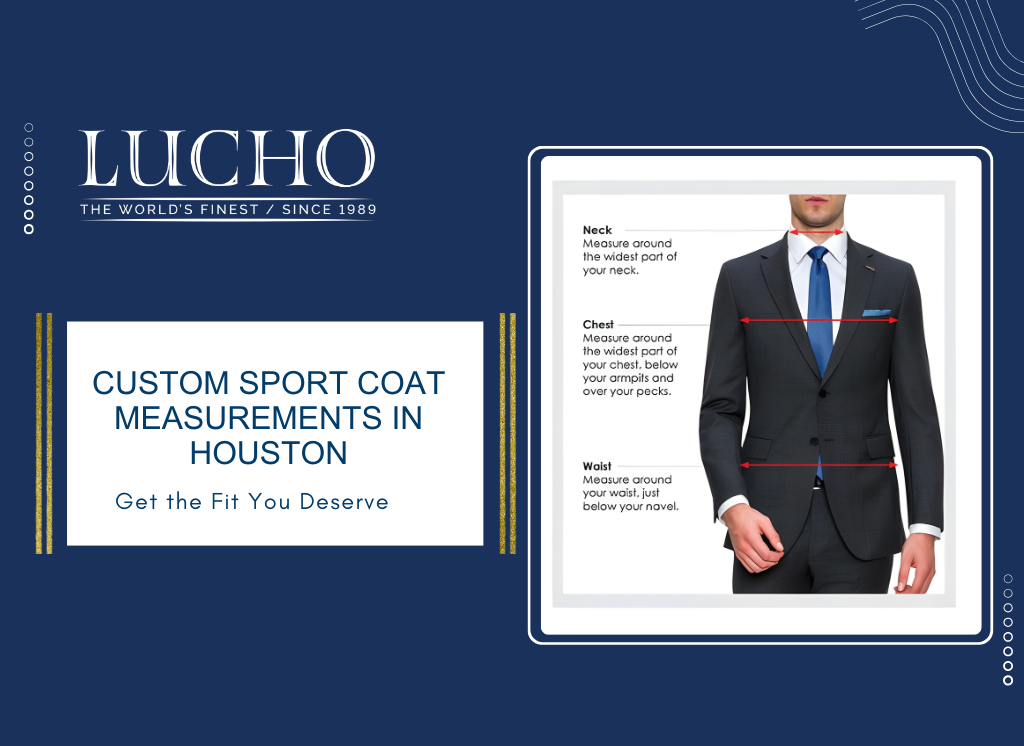
You need soft fabric tape, a thin shirt, good posture, and, ideally, a second person for the shoulder and sleeve. Measure twice, write down each number, and use them for any sport coat you buy. Here is a quick reference, followed by the detail for each measurement.
| Measurement | How to Take It | What It Controls |
|---|---|---|
| Chest | Around the fullest part, under the arms, tape level, one finger of room | Your base jacket size (a 40-inch chest is roughly a size 40) |
| Shoulder | Across the back, from one shoulder bone point to the other | How the coat sits; hardest area to alter |
| Sleeve | From the shoulder point down a bent arm to the wrist bone | Where the cuff ends; aim to show a bit of shirt cuff |
| Jacket length | From the base of the collar straight down the back | Coat proportion; classic length covers the seat |
| Waist | Around the natural waist, standing relaxed | The coat’s shape and suppression through the body |
1. Measure Your Chest for Sport Coat Size
Wrap the tape around the fullest part of your chest, under your arms and across your shoulder blades, keeping it level all the way around. Breathe normally and stand relaxed; don’t puff up or hold your breath, since holding it inflates the number. Leave enough room to slip one finger between the tape and your body. Measure twice and write it down. This is the most important number and sets your base size.
2. Take Accurate Shoulder and Sleeve Measurements
Measure shoulder width across the back, from the bony point where one shoulder ends to the same point on the other, keeping the tape flat. Get this one right, since the shoulder is the hardest part of a jacket to alter after it’s made. For the sleeve, start at the shoulder point and run the tape down a slightly bent arm to the wrist bone. Check both arms, since many people have one slightly longer, and let the coat sleeve end at the wrist bone so a quarter to a half inch of shirt cuff shows.
3. Get Your Waist and Jacket Length Right
Find your natural waist, around the level where your body bends, and measure there standing relaxed without sucking in. For jacket length, start at the base of the collar where it meets the shoulder and measure straight down the back to where you want the hem. A classic sport coat length covers the seat; a quick check: the hem should reach roughly the knuckles of your hand hanging at your side. Taller men carry a longer coat well, while shorter men look better in one staying closer to the hip.
4. Avoid Common Sport Coat Measurement Mistakes
The usual errors are simple and fixable. Don’t measure over a bulky sweater, since extra layers add inches; use a thin shirt instead. Don’t measure your own shoulders alone, since keeping the tape flat across your back is hard to do solo; get a second person to help. Use a soft fabric tape rather than a rigid ruler so it follows your body’s contours. Keep your posture natural, since slouching skews the chest and back numbers. And retake your measurements instead of reusing old ones, since weight and fitness change your chest, waist, and sometimes shoulders over time.
Where to Get Measured for a Sport Coat in Houston
If you’d rather not measure yourself, get it done in person at Lucho in Houston. Our tailors take and cross-check every measurement, then build the coat to those numbers, so the shoulders, sleeves, and length are right the first time instead of corrected afterward. Bring the shirts and shoes you plan to wear with the coat so we’re able to account for them in the fit. If you’re deciding between an off-the-rack fit and something built around your exact numbers, our breakdown of made-to-measure versus bespoke tailoring walks through the difference.
Conclusion
Five accurate numbers, chest, shoulder, sleeve, length, and waist, are what separate a sport coat fitting well from one almost fitting. Take them carefully, write them down, and refresh them when your body changes. Measure yourself with the steps above, or visit Lucho and let our tailors measure you, and the coat will do what it’s supposed to: look like it was made for you.
FAQs: How to Measure for a Sport Coat
The shoulder sets how the entire coat hangs, and it’s the hardest part to alter once the jacket is made. If the shoulder is off, the coat looks wrong no matter how well everything else fits, which is why tailors measure it first and most carefully.
Chest and waist are easy to measure alone, but shoulder width is hard to get accurate solo, since keeping the tape flat and level across a part of your back you’re unable to see is tricky. A second person, or a tailor, gives a far more reliable number for this measurement.
If you regularly wear a sweater or vest under the jacket, mention it when getting measured or account for it when measuring yourself, since a sport coat sized for a bare chest or thin shirt tends to feel tight over extra layers. A tailor factors this in during a fitting; measuring at home, add a small amount of room only if layering is a regular habit.
The sleeve should end at the wrist bone, showing about a quarter to a half inch of shirt cuff beneath it. This lets the shirt cuff peek out when the arm is at rest, which is the standard mark of a well-fitted jacket.
Retake measurements about once a year, or sooner after a noticeable change in weight, fitness, or muscle mass. Chest and waist shift the fastest, while shoulder width tends to stay more stable over time unless there’s a big change in build.
Contact Us
Recent Posts
- Your First Custom Suit Fitting: What Happens and How to Prepare
- What Is Cocktail Attire for Men? A Simple Guide
- Wool vs Linen vs Cotton: Best Suit Fabric for Houston Heat
- What to Wear to a Cigar Lounge: A Men’s Style Guide
- How to Measure Yourself for a Suit at Home (Easy Guide)
- Suit vs Tuxedo: The Real Difference (and When to Wear Each)
- The Return of the Double-Breasted Suit: How to Wear It in 2026
- Best Dress Pants for Men: The Ultimate 2026 Fit & Style Guide
- Black Suits Men: Style Guide & When to Wear Them
- Business Casual for Men: Modern Rules and Ideas for 2026